Measuring Success: Data Insights into Flagship Experience and B2B CLV
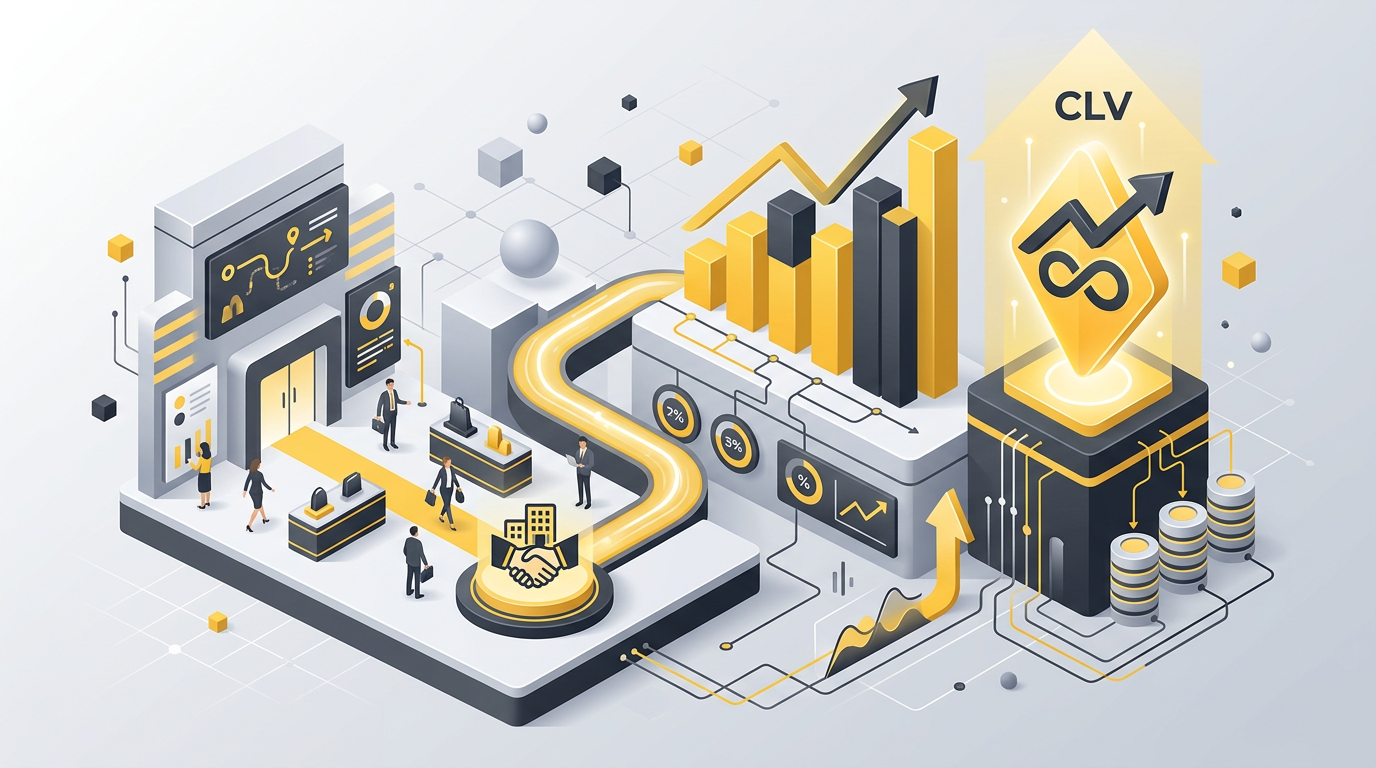
Stop Treating Your Flagship Like a Showroom
Most retail executives view their flagship stores as expensive marketing trophies. They look at the high rent in prime districts and hope the "brand awareness" justifies the burn. This is a mistake. In the B2B world, your flagship is a high-velocity conversion engine designed to maximize Customer Lifetime Value (CLV).
If you aren't tracking how a physical visit accelerates the contract renewal cycle of your corporate clients, you are flying blind. Data shows that B2B clients who engage with a physical experience zone have a retention rate 22% higher than those who only interact through digital portals or sales calls. This isn't about pretty lights; it's about reducing friction in the decision-making process.
Nota: Gráfico conceptual ilustrativo para representar la tendencia estratégica.
The Mathematics of the Retention Gap
Let's do some "napkin math." Imagine a B2B client with an annual contract value of $50,000. Without a physical touchpoint, the churn probability after year two is roughly 32%. By bringing that client into a flagship dedicated to "Experience Zones"—where they can test products in a simulated environment—you drop that churn to 10%. Over five years, that single store visit is worth an incremental $110,000 in revenue from one client alone.
Flagships serve as a physical manifestation of your service level. For a corporate buyer, seeing the infrastructure, the staff expertise, and the operational flow in person removes the "intangibility risk" that plagues B2B services. It moves the relationship from a line item in a budget to a strategic partnership.
Staff Productivity in Experience Zones
High-end retail often suffers from "wait-and-see" staffing. In a flagship optimized for CLV, your floor staff are not clerks; they are consultants. We track productivity not by transactions per hour, but by "Education Milestones." How many clients successfully completed a product demo? How many moved from a trial tier to a premium tier after a guided tour?
When you shift the KPI from immediate sales to account growth, you see a massive spike in staff efficiency. Data indicates that staff in dedicated experience zones handle 40% more high-value inquiries compared to traditional retail formats because the environment is designed to filter out casual browsers and focus on decision-makers.
Nota: Gráfico conceptual ilustrativo para representar la tendencia estratégica.
ROI: Long-term Loyalty vs. Short-term Rent
Stop obsessing over sales-per-square-foot in your flagship. That metric is for grocery stores, not for B2B-heavy brands. Instead, look at the "Influence Ratio." This measures how many offline visits preceded an online or contract-based purchase. In top-tier retail consulting, we see that for every $1 spent in an experience store, there is a $4.50 lift in lifetime value over the subsequent 24 months.
Investment in hardware (the store) pays off in software loyalty (the contract). If your flagship isn't driving your B2B renewal rates up, it’s just a very expensive billboard. You need to integrate your CRM with store check-ins immediately to close this data loop.
The Actionable Move
Audit your last 100 B2B renewals. Segment them by those who visited your physical locations versus those who didn't. If the difference in contract value is less than 15%, your store isn't an "experience"—it's just a warehouse with better flooring. Redesign the flow to focus on product education, not just product display. Your margins depend on it.